
Mineralised Qaurts

Stone with Quartz in
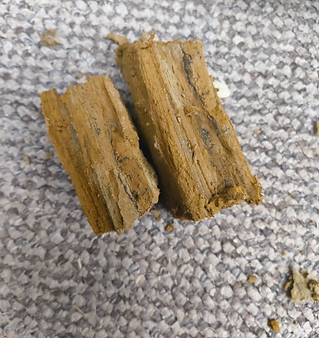
Iron Rich Clay from Cove Hithe
The significance of the Suffolk coast in the 9th and 10th centuries – Why coastal region and Lowestoft has Norse it in its bones.
If anyone who knows Lowestoft ever wondered why our beaches are so full of Quartz?Well…
The coast of Suffolk sits on a glacial deposit that was formed during the middle Pleistocene, I know that went over my head too as I’m not a geologist, and in turn is called the Lowestoft Formation.
The fascinating part however is that these specific deposits were brought over by the North Sea on ice sheets from the main Scandinavian landmass.The material composition of Suffolks cliffs and foreshore contains documented Scandinavian erratic’s, please bear with me, - minerals and rock types whose only possible origin is of the Norse landmass itself.
This is academically recorded and proven in not only geological literature, for which links will be shared at the end, but also held in the collections of the British geological survey.What this then shows is that practically the beach in Lowestoft, mainly north denes beach, contains the same minerals, stones, flint that originated in the landscape the Norse themselves inhabited.
Iron rich composite clay from Cove Hithe, Lowestoft’s quartz beaches and the varied mineral content of the specific glacial till share the same geological origin as Scandinavia did at that time. A Norse settler arriving and living in Lothu Wistoft and along the Suffolk coast would have understood the geology naturally.
Our beaches aren’t separated by the tumultuous journey of the rough North Sea’s that they had to navigate…. they were joined intrinsically because of it.
Not Anglo-Saxon, Not Norse but both.
References of Evidence
• A new stratigraphy for the glacial deposits around Lowestoft, Great Yarmouth, North Walsham and Cromer — directly names the Lowestoft Formation and discusses Scandinavian ice advance: https://www.researchgate.net/publication/235219480
• The genesis and significance of the Middle Pleistocene glacial meltwater and associated deposits in East Anglia — confirms North Sea Drift ice brought Scandinavian erratics into the region: https://www.researchgate.net/publication/382069535
• The Pleistocene depositional history of the Norfolk-Suffolk borderlands — confirms Scandinavian erratics in the North Sea Drift Formation deposits: https://www.researchgate.net/publication/274706986
• Unique graptolite-bearing erratic pebble from the Lowestoft Till — specific find from the Lowestoft Till formation referencing Scandinavian ice sheet origin: https://www.lyellcollection.org/doi/full/10.1144/pygs2023-005
• Erratics and stones on the beach — accessible explanation of Scandinavian erratic stones including larvikite from Norway found in East Anglian deposits: https://www.northfolk.org.uk/geology/erratics.html